Showing posts with label concertos. Show all posts

Monday, August 5, 2013

Developing aural memory

Nothing helps advance memorization practice like actually knowing how a piece sounds. From that point, having a good ear and being able to apply that ear to your instrument will make the memorization process move very quickly.

There are different degrees of knowing how a piece sounds, of course. You may have heard something for many years, giving you the freedom to play the piece by ear. Or maybe you've heard a piece several times, and you can pick out many, but not all, of the notes without a score.

But what if you've never heard a piece before? Many musicians will turn to recordings to help get to know a piece. I can't begin to express what a bad idea this is. For one, you'll learn a performer's interpretation. That's what's going to stick in your ear when you start playing the piece. Maybe you'll try to solve this problem by listening to several different interpretations. But you simply can't know what effect this is having on your own interpretation, and I feel that, in order to be authentic to yourself, you should be making your own interpretive decisions. Skip the recordings and allow yourself to learn a piece the right way: the slow way. Patience!
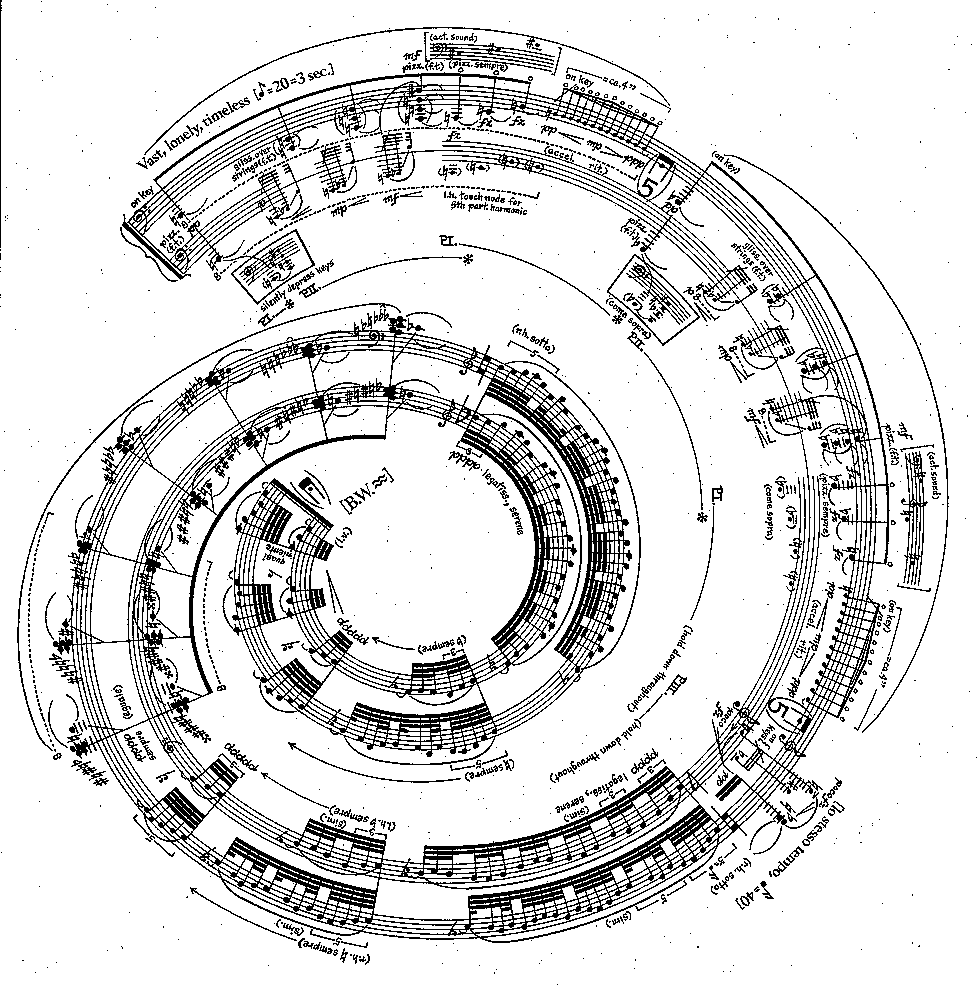

If you're working on a contemporary work, recordings might not even be available. In many cases, you have a unique advantage: you can talk to the composer. Many composers won't tell you how to play their music (although some will insist), but they can give you an idea of what it is they had in mind when writing the piece. 

(Now here's a funny thought for those who disagree with my stance on not listening to recordings: What were the composers listening to when writing your piece? They didn't need a recording to figure out how it sounds!)

One of the hardest things is to memorize a piece that you thought you heard differently. When something's already in your ear, it's pretty hard to erase it. With that in mind, you should be careful about what and whom you listen to.

In conservatory, I had a colleague who had a brilliant memory. He had no money to buy scores, so he would take them out of the library on Friday night, memorize them over the weekend, and then return them to the library on Monday. When it got time for performance class, the students would enjoy following his playing with the score, because he had surely memorized wrong notes, wrong dynamics, and a myriad of other missteps. He did have a brilliant memory, but he was very sloppy in its application. 

There's one area where I advocate the use of recordings: concertos. In this case, recordings can be used to learn your cues. Since rehearsal time with orchestra is always very limited, knowing your cues cold is very helpful, and, while you could use your imagination, nothing helps like knowing exactly how the orchestration should sound.

I know that this post doesn't offer much advice on developing aural memory. If you've really never heard your piece before, your aural memory might come last in the process. But you can be assured that, if it's last, you've got a very solid foundation to work with. Just be patient, and let your three memory types work slowly together to create well-rounded retention.

And what about developing a better ear? I'm afraid that's an entirely different topic. Suffice it to say that you can never have too good of an ear.


Friday, July 19, 2013

Landmarks

You now have your practice log, and now it's time to get organized. The practice log does more than just remind you of what pieces you've practiced and what you need it do. It also helps you keep track of landmarks.

Landmarks are, in short, rehearsal letters. (Orchestral players know what these are, but keyboardists may not. These are editorial letters in scores so that the conductor can tell everyone to start at "C" or "D" or wherever. This works beautifully, except when the conductor has a different edition from the rest of the orchestra.)

As you know, solo repertoire doesn't come with rehearsal letters, so you're going to have to make your own. But before getting into how to do that, we should consider why we're doing this at all.

Landmarks are those places to where you'll jump backward or forward when you have a memory lapse. (I write "when" because it's going to happen sooner or later.) Landmarks need to be in logical places, and they also have to be in places where you'll be able to make a seamless transition. In other words, landmarks should be where phrases naturally rest. Yes, it's really important to know the music theory behind your score, but you don't necessarily need to know the theory to find the phrases. Use your ear and your instinct.

Placing landmarks is kind of fun, because it's nice to see a piece break up into manageable sections. Sometimes, in a piece with which I'm very familiar, I'm able to mark landmarks right away. But if I don't know a piece too well, I'll add landmarks much more carefully, only marking them out as I work my way through the memorization of the piece.

Sometimes I use actual letters, but the problem with letters is this: They're much too firm. For instance, I'm currently working on the third movement of Bach's Concerto in d minor. I finally got around to working on my letter "N," only to find that my "N" was much too long. Since I'd already written "O," the temptation was to just deal with the long "N," and tolerate the fact that this landmark was too big. But that's not good practice! (Remember patience...) So, I ended up creating N1 and N2, a simple solution. More often than not, however, I tend to draw asterisks in my scores. I don't feel a need to enumerate my landmarks; I only need to know that they're there.

Some writers on memorization have said that you should be able to begin playing from anywhere in a piece. They also suggest jumping around in your practice, apparently so that you'll be able to recover from anywhere in the score. But this only confuses matters. Knowing that audiences expect musical phrases, we can assume that musically placed landmarks will help you survive lapses in the most musical manner. Jumping from, say, measure 101 to measure 55 just because you can is not a musical decision. Be logical, be musical.

Once those landmarks are placed--and remember, they can always be changed or moved--, I begin work on the piece. Lately, I've been doing the following: I memorize the final landmark and then go to the first, then the penultimate, then the second. This seems to pace things patiently, and it keeps me from becoming too excited about finishing a piece. Believe me, I've memorized pieces where the last page isn't memorized as well as the rest of the piece. That's happened when I've rushed the process out of impatient excitement. (Well, it is fun to finish a lengthy project!)

In the case of the Bach concerto movement, I've been leapfrogging landmarks (A-C-E-G, etc.). I've gotten to the end of the piece, and now I'm filling in the blanks (ABC, CDE, EFG, and so on). In my just-started C# minor Fugue (Bach: WTC I), I decided to begin on the landmark at the top of each page and work my way down, thus trying to learn four landmarks at a time. While I make many of these choices for the sake of variety in my practice, in the case of the Bach fugue, it's a piece I have never played before nor heard much at all. I don't know where I'll ultimately be putting my landmarks, but, by jumping around, I'm able to keep better musical track of the scope of this five-voice fugue and Bach's magnificent voice-leading.

This brings us to the most important part of landmark work. Once a piece is memorized, one must know the landmarks backwards and forwards. Indeed, knowing the landmarks becomes, in some ways, more important than knowing individual notes. I make sure that I'm able to start from each landmark; that I know where each landmark sits in the score; and that I'm able to visualize each landmark's starting point. When I have a piece memorized and I'm working away from the instrument, I don't visualize the piece from beginning to end. Instead, I work from the last landmark to the first, making sure that I am fully able to be at any section of the piece at any time as needed.

A final work with regard to concertos: In a concerto, you have nowhere to go but forward. The orchestra is dragging you along, but only in the forward direction. But in a solo piece, you can easily get caught in a loop, start over again, or who knows what. In this regard, I tend to think of concertos as being two-dimensional. They can only go in a temporal line from here to there. Solo repertoire is three-dimensional. In a lapse, solo repertoire has the potential to go up, down, left, right, backwards, forwards. Thank God for landmarks!


Friday, June 28, 2013

Keep walking

After making my way through some baby steps towards a few memorized pieces, I established a few ground rules for future work, and I still follow these rules today:

Above all, program planning is of utmost importance. Memorization takes time, a lot of work, and a lot of maintenance. I have to be extremely careful to choose works that I feel I'll want to play for the rest of my life. Life is short, so why devote it to B-list composers or compositions? More so, why make your audience hear anything but the best? I'm sure that some audience members don't need to hear Bach's Italian Concerto again, but it's a useful
piece for any keyboardist to have in his or her repertoire--and it's an excellent piece of music. Without getting too much into how to build a program, just consider that every piece you commit to memory should be something that you'll play for more than one season. If not, is it really worth your time?

In that same vein and as one who returned to memory after years of playing from score, I focus at least 50 percent of my time on works I've already played. Why reinvent the wheel? If I've already played A-list works successfully years ago with music, why not make them part of my permanent memory? This approach immediately helped me to build some repertoire. In most cases, I've been able to memorize the previously learned (but not memorized!) music in less than half the time of new works. All in all, I try to keep a healthy mix of old and new repertoire, but all with the purpose of committing these works to memory.

Given my unique case, I feel that I have a big gap in the concerto repertoire, so I've also made learning one concerto at a time a top priority. Oh, sure, I have concerto repertoire...but now it's time to memorize it! In conservatory, we musicians are always forced to learn concertos with, quite possibly, little hope of ever playing them in front of an orchestra. But what if that opportunity arises? One never knows, and it would be a real shame to turn down a good opportunity. (As with many thoughts on this blog, this is the sort of thing I was told and taught years ago by my conservatory piano teacher, Michael Ruiz.) 

As discussed in the previous post, patience is extremely important when working towards playing by heart. For this reason, I insist on working pieces in different stages of development. Starting everything from scratch at the same time is deadly to one's patience, focus, and motivation! I'll go into more detail later when I discuss the use of a practice log and a timer, but, to start, a typical practice session for me might include these types of pieces:

  • brand new work (30')
  • review of almost-completed work (20')
  • half-learned concerto movement (40')
  • review of ready-to-go work (15')
  • start memorizing previously learned work (30')
Again, I'll get more into this when I discuss the practice log, but it's important to note that the "ready-to-go work" takes the least amount of my practice time.

Finally, because memorized repertoire is permanent repertoire, it's a good idea to review what you've spent so much time to learn. It's probably impossible to keep everything fresh, but it's tragic to let your work wither on the vine. Is it possible to keep a full program ready all the time while learning another program? Maybe--although I don't have enough practice time in the day. But it should be possible to keep a half program alive. Since "ready-to-go" pieces take less time to practice, why not play 15 minutes of concert repertoire each day? Keep it ready, keep it fresh. Your audience needs you!


Friday, June 21, 2013

(Why you shouldn't memorize: Part the Second)

All political correctness and historical correctness aside, I think there are some very good reasons why and when one shouldn't perform from memory.

First, there really isn't a solid tradition of performing ensemble music from memory. One might consider concertos, but, then again, the orchestra isn't playing from memory. There is, very interestingly, a newer tradition of some classical ensembles, particularly in the early music world, performing from memory, but these seem to be anomalies. In some choral singing, there is a memorized tradition, particularly among children's choirs. The Philippine Madrigal Singers, a top-notch adult ensemble, perform from memory--and, I should add, seated and without a conductor.


Because I play chamber music with a variety of people, often playing the same pieces with different ensembles, I think that playing without music would be quite disadvantageous. I'm not suggesting that a memorized piece is a "learned" performance of that piece, but, in chamber music, we often need to mark up our parts as interpretive decisions are made. Keeping track of all of those decisions would be very difficult and could be disastrous in performance--and I'm not even referring to score-based memory lapses. I'm not saying that it's impossible, but, for me, memory work takes a lot of my time, and I'm not at the point in my career or interest where I want to devote that much time to my ensemble players. Were I a string player in a permanent string quartet, however, I think that playing the great quartet repertoire from memory with excellent colleagues would be a wonderful!


In the case of contemporary music, it's quite common to perform from score. Not only is the repertoire often hot off the presses with composers revising to the very last minute, non-tonal music can be wickedly difficult to commit to memory. More so, some contemporary composers don't expect their music to be played by heart.


Composer Larry Bell left this comment on an earlier post:

There is a book by (the late) Charles Rosen about Elliott Carter's piano music. At the time the book was written, Mr. Carter had not written very much piano music, so the book is a thin one and fundamentally about the one and only Piano Sonata (ca. 1945). 
At any rate, even in the 1950's Carter had a reputation as a composer who wrote difficult music. Rosen, showing himself to be  a progressive pianist, took on the Carter sonata and played it many, many times from memory. 
Once, when in the wings at Coolidge auditorium at the Library of Congress waiting to go on stage to play the Carter, a stage hand asked Mr. Rosen what piece it was that he was about to play. When Rosen replied the "Carter Sonata," the stage hand said, "Oh, that is a very difficult work."  
The concert was somewhat of a disaster, and from that time onwards Rosen was never again able to play the Carter Sonata from memory.

While this list of reasons why one shouldn't memorize is far from complete, I'll leave this final suggestion: One should not play from memory if a piece isn't learned well enough. Let's face it, we're all busy people, and we simply may not have enough time to commit a piece to memory. But this should not be the norm. We need to make more time for our practice, even if it means that we'll be performing a little less often.

And, as I've already suggested, working towards memory isn't just about the audience, it's also about our own musical development.